Why Solitary Bees Need Our Support
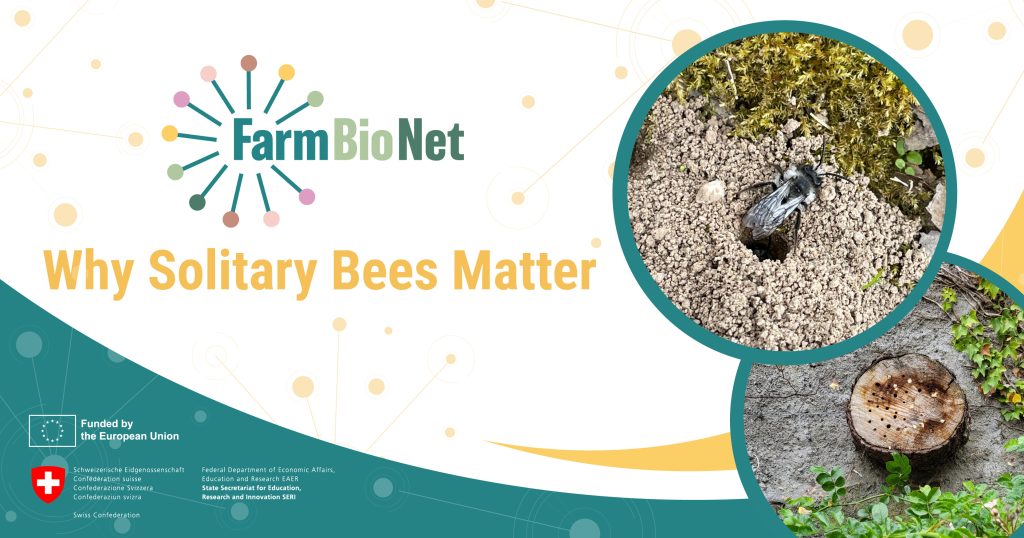
A bee moves between flowers in a field, a garden, a roadside verge, or a hedgerow. There is no visible hive, no beekeeper nearby, no honey to produce – only the bee, carrying out a vital service, pollination. An act that can go unnoticed by many.
It is likely a solitary bee, part of a vast and largely unseen group that make up the majority of bee species. Unlike honeybees and bumblebees, they do not live in colonies or produce honey. Each female builds its own nest, gathers pollen independently, and raises its young without a social structure behind her.
Yet their impact is anything but small. Solitary bees help to sustain wild plant communities and play a crucial role in the pollination of many crops.
Not All Bees Live in Hives
Popular culture has done excellent public relations for honeybees and bumblebees. When most people picture a bee, they imagine a black-and-yellow striped insect living in a highly organised colony ruled by a queen. Honeybees in particular receive the most attention, largely because of the products they provide to society, including honey, wax, and propolis, which are used in both the food, health, and the beauty industry.
But honeybees and bumblebees are the exception.
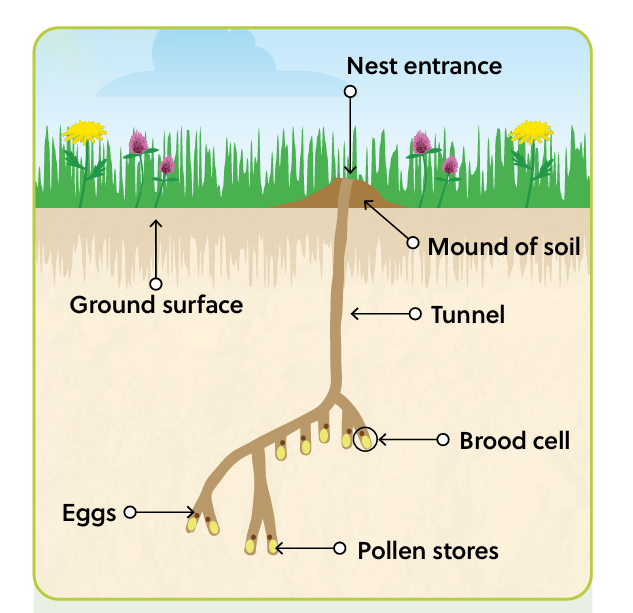
Around 90% of bee species worldwide are solitary bees. That means there is no hive hierarchy, no worker caste, and no bee monarchy. Individual female bees create their own nest (with the exception of cuckoo bees). They collect pollen to provision the next generation, carefully placing a single egg alongside a pollen mass. and sealing each brood cell. However, nesting strategies vary: cavity-nesting bees typically divide their nests into individual sealed chambers, while ground-nesting (mining) bees may organise their brood cells differently below the soil.
Some nest underground. Others use hollow stems, cracks in wood, or tiny tunnels in walls and trees. They are less “bee civilization” and more “tiny independent contractors with wings.”
Solitary Bees Are Surprisingly Easy to Help
The encouraging part is that supporting them does not require large-scale intervention. In many cases, small changes are enough to make a meaningful difference to something simple: more flowers, fewer pesticides, and space left slightly unmanaged – the kind of “mess” that nature often relies on.
1) Plant Flowers That Actually Feed Pollinators
Native flowering plants provide pollen and nectar that are well suited to local bee species. Diversity is also important: different plants flower at different times, ensuring food sources throughout the season and some bees prefer some flowers over others. Where possible, choosing locally native species from reputable sources can help ensure that they are the most suitable species for your area
2) Create Safe Nesting Spaces for Solitary Bees
Bee hotels can support cavity-nesting species, but they need to be properly designed and maintained. At the same time, most solitary bees are ground-nesting (mining) species that rely on bare, well-drained soil, sandy banks, and undisturbed ground rather than artificial structures. Creating a mix of bee hotels and small bare soil areas, sometimes called “bee scrapes,” can support a wider diversity of wild bees.
3) Reduce Pesticide Use
Reducing pesticide use is one of the most effective ways to support pollinators. Fewer chemicals in the environment generally means more stable and diverse ecosystems.
How to Create Solitary Bee Nest Sites on Your Farm
Solitary bees can be supported on farms by creating simple nesting habitats: mining bees need dry, sunny, well-drained bare soil patches (ideally on south- or west-facing banks along hedgerows or field boundaries), while cavity-nesting bees use drilled wooden structures or natural holes in stone or wood (holes should be about 4 – 10 mm wide and ~10 cm deep, placed 1-2 m above ground in sunny positions). In both cases, flowers must be nearby because bees typically forage only a few hundred meters from their nest, and sites should be left undisturbed year-round, with no pesticide use and minimal disturbance during the short active nesting period.
Protecting Solitary Bees Is About More than Bees
Supporting solitary bees is not just an insect conservation issue. It is about food security, biodiversity, resilient ecosystems, and the stability of the natural systems humans depend on.
These bees are not asking for much:
– flowers, (food)
– nesting spaces, (shelter)
– fewer toxins, (safety)
– and connectivity
For creatures so small, they hold together an astonishing amount of life. And unlike honey, the value they provide cannot be bottled, branded, or replaced once it is gone.
Market Values of Pollination Services
Pollinators play a crucial role in European agriculture, contributing significantly to food production and crop yields. Across the EU, insect pollination is essential for a large proportion of cultivated crops and wild plants, with wild bees making an especially important contribution. Around four out of five crop and wildflower species depend, at least in part, on insect pollination.
Take mason bees, for example. These solitary bees are highly efficient pollinators because their hairy bodies collect and transfer pollen very effectively. In some crops, mason bees can pollinate more efficiently per visit than honeybees.
Many fruits, vegetables, and wild plants rely on wild pollinators such as solitary bees, including apples, cherries, strawberries, tomatoes, and blueberries.
Ireland’s Pollival project used the dependence ratio approach to estimate the market value of pollination services, using global crop production and trade data from the FAO’s FAOSTAT database. A global modelling approach was adopted because Ireland is a net importer of animal-pollinated crops, meaning that changes in global pollinator populations could affect both domestic production and import prices (e.g. cocoa), potentially impacting Ireland’s trade balance.
Furthermore, the case studies examined how pollinator decline could economically affect four European countries – the United Kingdom, France, Spain, and Germany – showing that each country’s vulnerability depends on its crop profile and reliance on imports. In the UK, France, and Germany, much of the potential economic impact is linked to imported pollinator-dependent crops such as cocoa beans and coffee, alongside locally produced apples, making these countries vulnerable to global supply chain disruptions. Spain differs because it is a major producer and exporter of peaches, nectarines, and melons, so pollinator decline would mainly affect local agricultural production. Spain’s agricultural economy is also more diversified, while Germany is the most dependent on a small number of crops, with most projected losses concentrated in imported cocoa, coffee, and apples, increasing its exposure to fluctuations in global market prices.
The Quiet Problem of Being Overlooked
Honeybees appear everywhere: in documentaries, supermarket branding, skincare campaigns, even children’s books, where they are cast as nature’s cheerful mascots.
Solitary bees, by contrast, are far less visible. They tend to surface in scientific reports, biodiversity assessments, and the occasional ecological survey. Yet this lack of attention is not without consequence.
While honeybees are often actively managed within commercial systems, most wild bee species, including solitary bees, depend on suitable habitats that are increasingly fragmented and under pressure. Many solitary bees can only travel relatively short distances, making connected landscapes especially important for their survival and ability to forage. It is one of ecology’s more striking contradictions: some of the most important contributors to nature’s functioning are also among the least recognised.
The encouraging part is that visibility is not destiny. Once understood, solitary bees are surprisingly easy to support.
Why Solitary Bees Are Struggling - and Why They Can Still Bounce Back
1) Landscapes Are Becoming Too Neat for Nature’s Own Good
According to the EU Pollinators Initiative, habitat loss and landscape simplification are among the main drivers of pollinator decline in Europe.
From a distance, modern green spaces can look immaculate: trimmed lawns, clipped hedges, carefully cleared flowerbeds. But to a pollinator, much of this resembles a biological desert.
Wildflowers are replaced. Bare soil is sealed or paved. Dead wood – once a vital nesting resource – is removed. Hedgerows, those unruly but ecologically rich corridors, gradually disappear. The result is a landscape designed for visual order rather than ecological function.
Nature, as it turns out, is not particularly invested in straight lines.
And solitary bees, which depend on small pockets of messy, diverse habitat, are among the first to feel the loss – and among the species that benefit most when even a little disorder is allowed back in.
2) Pesticides Do Not Stay in Their Lane
Pesticides are often discussed as tools for targeting “problem” species. In practice, their effects are far broader.
Even at low exposure levels, certain chemicals can interfere with bees’ navigation, reproduction, and immune systems. For solitary bees, the impact is particularly acute: there is no colony buffer, no shared labour, no backup system. One affected individual can mean the loss of an entire reproductive effort.
It is a reminder that in nature, systems are interconnected in ways that do not always respect human categories of “pest” and “pollinator”.
3) Climate Change Is Disrupting Nature’s Timing
Spring is arriving earlier. Heatwaves are more frequent. Seasons are becoming less predictable. For bees and plants, timing is everything. Their life cycles evolved in sync – flowers bloom when pollinators emerge, and pollinators emerge when food is available.
Climate change is increasingly breaking that synchrony. It is a bit like two colleagues showing up for a meeting – one in January, the other in March – technically on time, just not for the same calendar.
The encouraging part is that while these shifts are real, they are not irreversible at local scales. Habitat diversity and resilient landscapes can help buffer some of these mismatches.
How FarmBioNet Helps?
Projects such as FarmBioNet show how the challenge of declining pollinators can be addressed in practice. By supporting biodiversity-friendly farming and promoting more responsible approaches to pesticide use, the project helps translate EU biodiversity goals into everyday land management. In doing so, it works to reconnect agriculture with ecological processes – creating landscapes where food production and pollinator survival are not competing priorities, but part of the same system.