Farming with Nature: Insights from José Fernando Robles
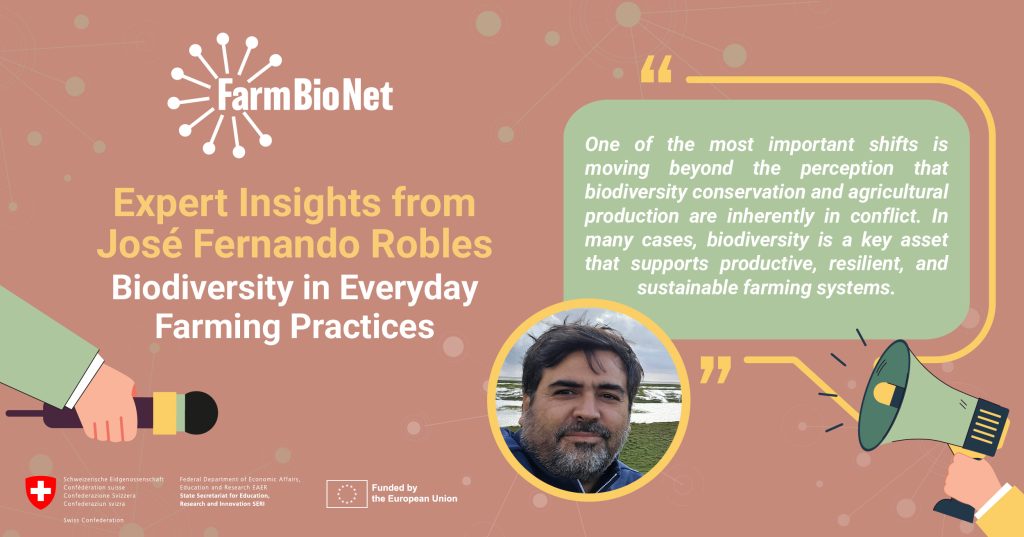
José Fernando Robles is Head of Sustainability and Coordinator of the FarmBioNet National Network in Spain. With over 25 years of experience working alongside farmers at ASAJA-Sevilla, he has a first-hand understanding of the link between agriculture and biodiversity. In this interview, he shares his perspective on the challenges and opportunities for making agriculture more sustainable and resilient in the face of environmental change.
Could you tell us a bit about your professional background and what led you to work in the field of biodiversity?
I have spent more than 25 years working at ASAJA-Sevilla, mainly advising farmers on agricultural sustainability and the practical implementation of environmental and agricultural policies. Throughout my career, I have also participated in numerous European and national projects aimed at supporting farmers in overcoming challenges related to climate change adaptation, soil and water conservation, maintaining biodiversity in agricultural areas, and the adoption of more sustainable farming practices that balance productivity with environmental performance.
Working directly with farmers has given me a unique perspective on the close relationship between agriculture and biodiversity. I have seen first-hand how healthy soils, pollinators, natural enemies of pests, and diverse agricultural landscapes contribute to the resilience and long-term sustainability of farming systems. This experience led me to become increasingly involved in biodiversity-related projects and initiatives, always with the aim of finding practical solutions that integrate environmental conservation into everyday farm management.
For me, biodiversity is not an external requirement imposed on agriculture; it is one of the foundations of sustainable and resilient farming and strengthen the identification of European society with the agricultural sector. One of the challenges is to help farmers understand its value and provide them with the knowledge, tools, and incentives needed to incorporate biodiversity into their production systems in a practical and economically viable way.
From your experience, what are the most effective ways to integrate biodiversity into everyday farming practices?
The most effective measures are often those that can be integrated into normal farm management while also providing agronomic benefits. Examples include maintaining cover crops, preserving field margins and hedgerows, diversifying crop rotations, reducing soil disturbance through conservation agriculture, and improving habitat connectivity across agricultural landscapes.
It is also important that biodiversity measures are practical and economically viable. Farmers are more likely to adopt practices when they see clear benefits, whether in terms of soil health, reduced input costs, increased resilience to climate variability, or compliance with policy requirements. Successful integration requires demonstrating that biodiversity and productivity can reinforce one another rather than being viewed as competing objectives.
I believe it is crucial to ensure that the transition towards more biodiversity-friendly farming systems is supported not only by farmers, but also by society and policymakers. Farmers cannot be expected to bear alone the costs and risks associated with adopting new practices that deliver public environmental benefits. Society increasingly demands higher environmental standards from agriculture, and this should be accompanied by adequate economic support, fair market conditions, and policies that recognise the value of the ecosystem services provided by farmers.
The transition to more sustainable farming systems will only be successful if it is based on a genuine partnership between farmers, consumers, and public institutions, with sufficient incentives and long-term commitment to make biodiversity-friendly practices both environmentally and economically sustainable.
As the leader of the National Network in Spain within FarmBioNet, how would you describe your main areas of focus?
My main focus is to facilitate knowledge exchange among farmers, researchers, advisors, policymakers, and other stakeholders. Spain, and the Iberian Peninsula as a whole, is one of Europe’s most important biodiversity hotspots. Its great diversity of climates, landscapes, and farming systems supports an exceptional richness of species and habitats, many of which are closely linked to traditional agricultural practices. Systems such as the dehesa, Mediterranean olive groves, extensive grazing areas, and traditional mosaic landscapes demonstrate the close relationship between farming and biodiversity conservation.
Spain has a great diversity of agricultural systems, and there is already a wealth of experience and innovation taking place at farm level. Within this context, FarmBioNet provides an opportunity to identify, document, and share successful biodiversity practices that can be adapted to different agricultural and environmental conditions.
Another important priority is ensuring that scientific knowledge is translated into practical solutions that farmers can realistically implement. At the same time, we aim to bring farmers’ experience and traditional knowledge into the research process so that innovation responds to real needs and challenges.
What are the biggest challenges facing biodiversity in Spanish agriculture today, and which strategies or policies do you find most promising to address them?
Spanish agriculture faces multiple challenges, including climate change, water scarcity, soil degradation, habitat fragmentation, and increasing economic pressures on farms. In many regions, farmers are being asked to deliver environmental benefits while operating under highly competitive market conditions.
Agricultural systems with the highest environmental value are possibly the most sensitive to the serious situation of lack of profitability that some sectors are going through, as is the case in Spain with dryland herbaceous crops or traditional olive groves.
The most promising approaches are those that combine environmental objectives with economic sustainability. Agri-environmental schemes under the Common Agricultural Policy, results-based incentives, support for conservation agriculture, and investments in landscape-scale biodiversity initiatives can all play an important role. However, policies must remain practical, flexible, and adapted to regional conditions. Farmers need support, technical guidance, and adequate incentives to successfully implement biodiversity-friendly practices.
FarmBioNet aims to bring together traditional knowledge and research-based practices to support biodiversity on farms. What role do you see National Networks playing in this process?
National Networks act as a bridge between different communities of knowledge. Researchers generate valuable scientific evidence, while farmers possess practical experience gained over generations. Both forms of knowledge are essential.
The role of the National Network is to create opportunities for dialogue, mutual learning, and collaboration. By bringing stakeholders together, we can identify successful practices, understand barriers to adoption, and accelerate the transfer of innovation. Networks also help ensure that biodiversity solutions are adapted to local realities rather than being developed in isolation from farming practice.
How engaged are farmers and other stakeholders in your network?
Engagement has been very positive. Farmers increasingly recognize the importance of biodiversity, particularly as they experience the impacts of climate change and environmental degradation. Many are interested in practical solutions that improve both environmental performance and farm resilience.
We have also seen strong participation from advisory services, research institutions, environmental organizations, and policymakers. While stakeholders may have different perspectives, there is growing recognition that collaboration is essential to achieve meaningful progress. The network provides a valuable platform for these conversations and partnerships.
Looking ahead, what key actions or mindset shifts do you believe are needed to protect and restore farmland biodiversity over the next decade?
One of the most important shifts is moving beyond the perception that biodiversity conservation and agricultural production are inherently in conflict. In many cases, biodiversity is a key asset that supports productive, resilient, and sustainable farming systems.
Over the next decade, we need greater investment in farmer education, advisory services, innovation, and demonstration projects. We also need policies that reward environmental stewardship while maintaining farm competitiveness. In this regard, the next Common Agricultural Policy for the 2028–2034 period will be crucial. It offers an opportunity to further integrate biodiversity objectives into agricultural policy through well-designed incentives, support for results-based approaches, and measures that recognise and reward the environmental services provided by farmers. Therefore, the future CAP should provide farmers with stable, practical and adequately funded instruments that encourage the adoption of biodiversity-friendly practices, while preserving the economic viability of farms.
Utilmately, stronger collaboration among farmers, researchers, policymakers, and society as a whole will be essential. Protecting biodiversity is not solely the responsibility of farmers; it is a shared challenge that requires collective action and long-term vision.