Eighteen Months of Growing a Network Committed to Biodiversity and Farming

Eighteen months can lay the foundation for something meaningful.
For FarmBioNet, they have meant bringing together farmers, researchers, advisors, foresters, and other stakeholders from across Europe to exchange knowledge, showcase practical solutions, and strengthen a growing community dedicated to biodiversity-friendly farming.
Over the past few months alone, the project has reached several important milestones: rom international meetings and field exchanges to new knowledge resources, outreach activities, and scientific contributions. Together, these achievements are helping make biodiversity-friendly farming more accessible, practical, and visible across Europe.
Project partners in two countries
FarmBioNet’s recent activities have demonstrated that collaboration happens in many different settings. Sometimes it begins around a meeting table, while other times it takes place in fields, meadows, and on farms where biodiversity-friendly practices can be experienced first-hand.
Our partners first came together in Florence to review progress, exchange ideas, and shape the next steps of the project. Just a few weeks later, the conversation continued in Romania, this time outdoors, where biodiversity-friendly farming practices could be seen, discussed, and experienced first-hand.
Consortium Meeting in Florence, Italy
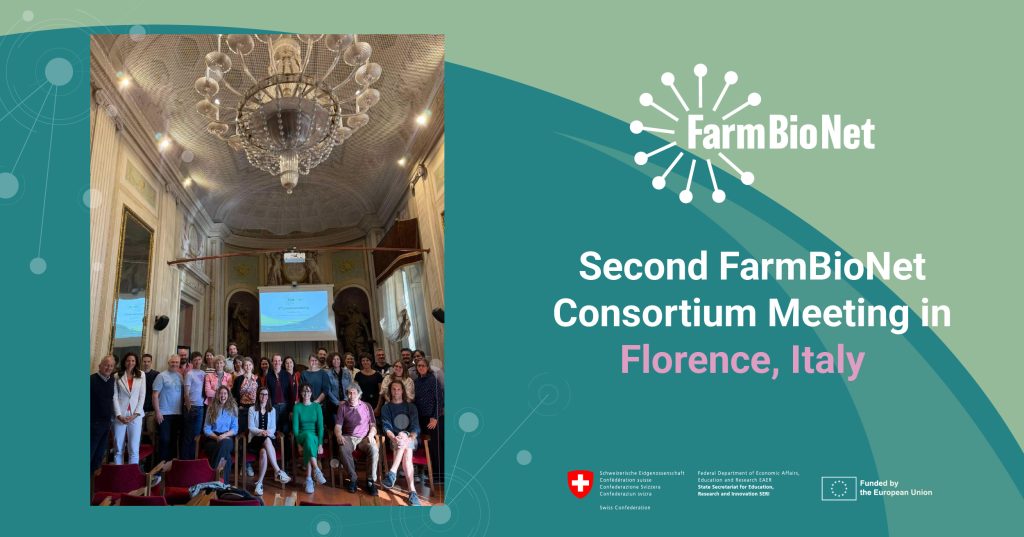
In May, project partners gathered in Florence, Italy, for the second Consortium Meeting, hosted by the Department of Agriculture, Food, Environment and Forestry (DAGRI) at the University of Florence. Over three days, partners reviewed project progress, shared updates from the 12 National Networks, discussed ongoing activities, and planned the next phase of the project. A field visit through the Tuscan countryside complemented the discussions by showcasing biodiversity-friendly farming practices in action. A detailed account of the visit is available in a blog post by our partner Simona Missmann (FiBL).
International Exchange Visit in Romania
Just a few weeks later, FarmBioNet project partners and farmers from all 12 National Networks gathered in Sighișoara, Romania, for the project’s first International Exchange Visit, hosted by Fundația ADEPT Transilvania.
We were also pleased to meet the Mayor of Sighișoara, Iulian Sîrbu, who joined the evening gathering to welcome Project Coordinator Saorla Kavanagh and all participants. The exchange visit provided a valuable opportunity to learn through field demonstrations, practical examples, and peer-to-peer exchange. The programme included visits to Albești SEBAL Farm, Angofa Demonstration Farm, and the Viscri Common Grazing Association, where participants explored different approaches to grassland management, rotational grazing, habitat conservation, agroforestry, and livestock production.

FarmBioNet at a glance: new video release
Curious about what FarmBioNet is all about?
Our first promotional video, produced by the coordinating organisation Teagasc, offers a concise introduction to the project and its vision. In just a few minutes, you can learn about FarmBioNet’s objectives, collaborative approach, expected outcomes, and the impact we aim to create for farmers, advisors, researchers, and the wider agricultural community.
Best practices for biodiversity-friendly farming
Looking for practical ideas to support biodiversity on your farm?
Practice Abstracts (PAs) translate research and knowledge into accessible, practice-oriented guidance for end users. They highlight solutions applicable across different farming and forestry systems, production sectors, and biogeographical regions. The first batch of Practice Abstracts covers a wide range of biodiversity-friendly farming topics, including:
- Reducing the frequency of hedgerow cutting as a biodiversity-friendly practice
- Hedgerow planting: what and where
- Paludiculture as an alternative to peatland, marsh, and bog drainage
- Creating and maintaining small water bodies
- Avoiding soil compaction and promoting soil life
- Enhancing biodiversity through intercropping, polyculture, and crop rotation
- Cover crops in permanent crops for soil health, biodiversity, and resilience
- Catch crops for soil fertility and farm profitability
- Managing fallow land for biodiversity and soil protection
- Maintaining traditional orchards
- Planting native trees
- Managing deadwood to support ecosystems and forest resilience
- Preserving and restoring dry-stone walls
- Combining traditional ecological knowledge (TEK) with scientific research
- “From measure to practice: do it, then get paid” approaches
- Extensive permanent pastures with rotational grazing
- Alpine hay meadows and traditional management
- Restoring wet meadows for biodiversity, carbon storage, and water retention
- Silvopasture to reduce heat stress in
- Mediterranean systems
- Restoring bogs and supporting land stewardship incentives
- Biodiversity-friendly farming with zeolite as a natural soil solution
All Practice Abstracts are freely available on the FarmBioNet website.👉
First project infographic released
FarmBioNet has also published its first project infographic, highlighting key figures and milestones from the project’s first year. It also highlights several biodiversity-friendly farming practices already being implemented by farmers across Europe.
To ensure accessibility, the infographic is available in multiple languages on the FarmBioNet website:

Other updates from the project
FarmBioNet at major agricultural fairs: FarmBioNet recently expanded its outreach by participating in two key agricultural events in Europe.
At the AGRARIA Forum in Romania, partner Fundația ADEPT Transilvania presented the project during a workshop on sustainable agricultural practices, highlighting the importance of biodiversity-friendly farming.
The project was also featured at the 93rd International Agricultural Fair in Novi Sad, Serbia, where partners from Future Systems Hub engaged with visitors and shared knowledge on biodiversity-friendly farming practices.
Featured in webinars: Project Coordinator Dr Saorla Kavanagh presented FarmBioNet in the Teagasc Signpost Series in a session titled “Beast of Burden – How Can We Enhance Biodiversity on Farmland?”, focusing on practical approaches to biodiversity enhancement.
A recording of the session is available online, here:
Expert Insights campaign:why biodiversity matters
FarmBioNet has also launched an Expert Insights Interview Series, where leading voices from across the consortium share their perspectives on biodiversity-friendly farming.
Among them, Dr. Darko Znaor, Executive Director of the Avalon Foundation, reflects on why biodiversity is the foundation of sustainable agriculture. He discusses the relationship between farming practices and biodiversity, the benefits for both farmers and society, and the challenges and opportunities ahead.
Explore the full interview and other expert insights in our Newsroom.
Research insights from FarmBioNet
FarmBioNet continues to contribute to scientific discussions on biodiversity-friendly farming through participation in several international conferences:
- TEAGASC presented at the Environ 2026 Conference (Dundalk, Ireland), discussing farmer perspectives on biodiversity-friendly practices across Europe.
- TEAGASC also presented at “Agriculture and Land-use in Ireland – Pathways to a Sustainable Future” (Portlaoise, Ireland), focusing on incentives for biodiversity-friendly practices.
- ZALF contributed at the 73rd Annual Meeting of the German Society for Bee Research (Braunschweig, Germany) with insights on pollinator-friendly farming and incentive design.
- STUDIA presented at the SGA Annual Conference in Switzerland on new business models for biodiversity-related land-use measures.