Expert Insights from Ben Mehedin: Lessons from High Nature Value Farming in Romania
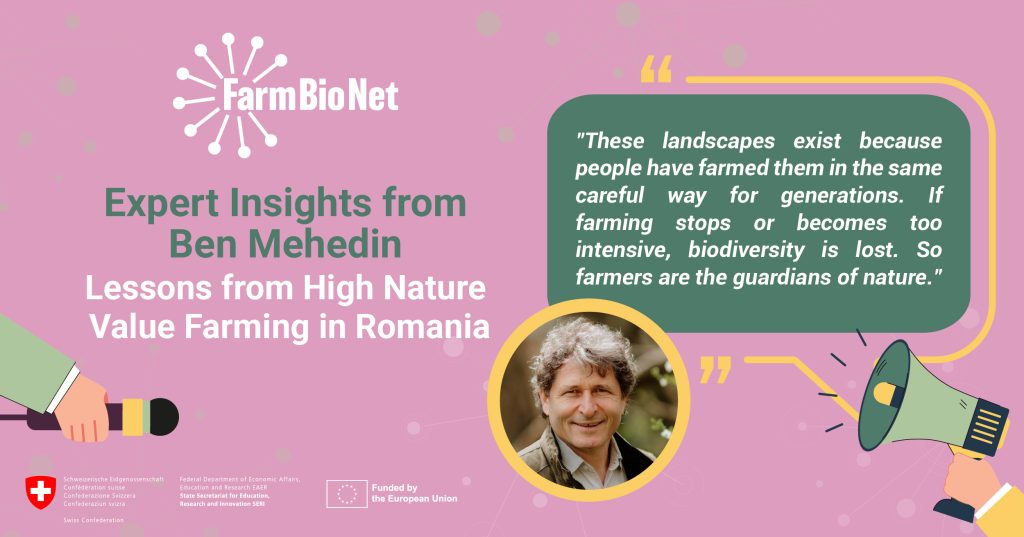
Ben Mehedin is a Rural Development Agent at Fundația ADEPT Transilvania and leads the Romanian National Network in FarmBioNet. His work covers EU-funded agricultural and conservation projects, farmer training, local food production and marketing, and support for small social economy businesses. In this interview, he talks about High Nature Value farming, why farmers are the guardians of these landscapes and what other European regions can learn from Transylvania, and more.
Could you tell us a bit about your professional background and what brought you to work with farmers, rural communities and biodiversity conservation at Fundația ADEPT?
I am a Romanian peasant at heart, father of four, in my sixth decade of life. After graduating in macromolecular chemistry, I worked in some communist plants, now extinct (so, at least from this point of view, I know what this means). Then I was involved in community and rural development projects. I specialised in farmer training, food production, food branding, hygiene and marketing, including farmers’ markets, agriculture, climate change and food safety. I am a kind of Rural Development Agent at Fundația ADEPT Transilvania. I also lead the Romanian National Network in FarmBioNet. I live and work in the Târnava Mare region of Transylvania.
My work is on EU-funded agricultural and conservation projects. I help farmers and local communities to understand the actual framework in the European context. I also support small social economy businesses with their documents and grant applications.
What brought me here is the landscape itself, which is a co-creation output between nature and humans’ traditional practices. The meadows, the villages and the traditional knowledge of the people are very special. I would like locals here to understand how valuable this landscape is as long as it’s kept alive, and to be aware that farming and nature can work together. It’s not just the landscape, but everything that comes along with it: clean air, pure waters, pollination, biodiversity, carbon sequestration, connectivity.
Fundația ADEPT works closely with High Nature Value (HNV) farming systems in Transylvania. What makes these landscapes and traditional farming practices so important for biodiversity?
HNV farmland is shaped by low-intensity farming. The farmers in this area inherited a landscape shaped this way by a Saxon population, which farmed carefully with regard to the resources. They scheduled the activities according to the seasons and, helped by the landscape, they split the use of the land into three: one third arable, one third grasslands and one third forest. Then they cut the grass at the appropriate time, grazed animals at moderate levels and used very few chemicals or none at all. Because of this, meadows and pastures stay rich in plants, insects, birds and other wildlife. They didn’t do all of this for nature, but to earn a living. In their choices, everything was important: the natural resources, the community and the economy of their households. In this way High Nature Value landscapes were shaped.
A single traditional meadow can hold a great number of plant species. Those plants feed insects, and the insects feed birds and other animals. The mosaic of meadows, hedges, scrub and small woods gives shelter to many species.
These landscapes exist because people have farmed them in the same careful way for generations. If the farming stops or becomes too intensive, the biodiversity is lost. So the farmers are the guardians of this nature. We strongly believe that nature conservation can be done with the farmers as custodians of these landscapes.
From your experience working directly with farmers, what are some of the most effective ways to encourage biodiversity-friendly farming practices while also taking farmers’ economic realities into account?
First, we must listen. Farmers know their land better than anyone. They will only change if the change makes sense for their farm and their family.
Second, biodiversity-friendly farming must pay. Fair support payments help. So does a better price for local and traditional products. When people see that nature-friendly farming brings income, they continue with it. Sometimes a biodiversity-friendly farming practice may reduce the costs (such as the biological fight against pests) or increase production (like when benefiting from the effect of a friendly environment for pollinators).
Third, farmers need clear and simple help. Many find the rules and the paperwork difficult. Good advice, practical training and help with applications make a big difference.
Finally, farmers learn best from other farmers. Visits to neighbouring farms and shared experience are often more powerful because seeing it working in practice can count for a lot more than all the books.
You work across farmer training, extension services, community engagement and school activities. How important is it to connect these different groups and generations when it comes to protecting farmland biodiversity?
It is very important. Farmland biodiversity is protected by people, and it needs every generation.
Older farmers hold traditional knowledge. They know when to seed, work the land and cut the grass, where to graze and how the land changes through the year. Young people bring new ideas, new skills and energy. Children will be the farmers, consumers and decision makers of the future.
When these groups meet, knowledge is passed on. Children learn to value the meadows. Farmers feel respected for what they know. Advisors understand real needs on the ground. In this way, conservation becomes part of village life and not something that comes from outside. Somehow, the care for nature is in our DNA. I once asked one of our farmers what he does for biodiversity on his farm. He said: “I do what my father did, what my grandfather did and what my great-grandfather did.” So, the care and respect for nature used to be learnt in the family.
All this dialogue leads, in the end, to mutual respect between the different age groups.
What are some of the main challenges that small-scale farmers face today, and how can better support for biodiversity also contribute to the resilience of these farming communities?
Small-scale farmers face many pressures. Incomes are low. Farms are small and often fragmented. Many farmers are older, and young people leave the villages. Markets are hard to reach because the quantities and production frequency are low. As long as conventional agriculture doesn’t consider the losses in costs, there cannot be justice for small-scale farmers. All of these challenges are backed up by the administrative rules in order to transform small-scale farming into an impossible mission to survive.
So, to surpass these challenges, a better system which pays for positive externalities, such as clean air, pure water, avoiding soil degradation and biodiversity loss, will not only encourage the activities which provide all of these common goods, but will also make the world better for each one of us. Fair payments for looking after meadows give farmers a more stable income. Support for local products and short supply chains helps them to sell at a better price. A healthy landscape also brings other benefits, such as good fodder, clean water and rural tourism.
In this way, protecting nature is not a cost for the farmer. It can be a base for a stronger local economy.
As the leader of the Romanian National Network within FarmBioNet, what have you found most valuable about bringing farmers, advisors, researchers and other stakeholders together?
The most valuable thing is mutual understanding. For me, as an observer, it is fascinating to see how the information exchange goes. Farmers know the practical reality. Advisors know the support schemes and the rules. Researchers bring evidence and data.
Through FarmBioNet, they have the chance to sit at the same table, and the discussion becomes more passionate, honest and more practically oriented. Researchers hear real needs from farmers. Farmers see that their experience is taken seriously. Solutions are more practical, and people trust each other more.
A network also shows farmers that they are not alone. Others face the same questions, and some find out the answer from another network member, or they find answers together. Sometimes the solutions they find go beyond biodiversity-linked problems to a much broader range.
FarmBioNet places a strong emphasis on sharing knowledge and experiences between countries. What can other European regions learn from the experience of High Nature Value farming in Transylvania?
Transylvania shows that biodiversity and farming can live side by side. Here, nature-rich landscapes are still part of everyday working life.
Other regions can learn how traditional management keeps meadows species-rich. They can also learn how local products, community work and cultural heritage support conservation.
We, in turn, can learn a lot from other countries. They have good experience in organising their farms and in the scientific approach to farming, and are more aware of the damage that unbalanced decisions can cause to farming in the long term. Our farmers can see a different approach and realise they can get ideas from people a lot more experienced in the economy of the farm. Also, our farmers can get a lot of ideas in farmer cooperation and/or payment schemes. Sharing both successes and difficulties helps everyone to improve.
In June this year, Fundația ADEPT hosted an international FarmBioNet exchange visit in Sighișoara. What did participants from other countries find particularly interesting about the Romanian experience?
Our visitors were most interested in seeing the landscape and the farming practices with their own eyes. They saw how traditional, low-intensity farming still shapes the countryside.
They also showed great interest in the people behind it. They wanted to understand how farmers, local organisations and advisors work together. They were curious about the link between local products, traditional knowledge and nature conservation.
Some found answers to their questions; some found the discussions interesting. Some realised that the people of Transylvania hold a treasure; some considered that they didn’t find new practical ideas. Among the other ideas in the feedback, one said that the whole program was well balanced.
For me, the best part was the open exchange. Participants compared the situation in their own countries and shared ideas. One of the most important things was that one of the farmers wanted to set up a discussion group for the future, which I personally find very useful. We all went home with new questions and new contacts.
Looking ahead, what would you most like to see change in Romanian farming and rural areas over the next decade to ensure that biodiversity and viable farming communities can thrive together?
First of all, the whole rural space should be considered in an integrated approach, with infrastructure and services, from the natural, economic and environmental point of view.
I would like to see small farmers and traditional farming better recognised and rewarded. Farmers who look after meadows and pastures provide a service to the whole society, and this should be reflected in the support they receive.
A very important achievement would be if a lot more people were interested in understanding farming and nature from the scientific and traditional ecological knowledge point of view. We are working hard to pass on this message.
I would also like simpler rules and easier access to funding and advice. Support should reach the people who need it most.
Finally, I hope to see more young people choosing to stay in the villages and farm. This needs good local markets, fair prices for local products and good rural services. If we achieve this, biodiversity and viable communities will grow together.
If you could give one piece of advice to a farmer who is interested in doing more for biodiversity but doesn’t know where to start, what would it be?
I would advise them, first of all, to look at the resources they have. After assessing which resources they have, I would suggest: “Act and do no harm!” Look at your own land and notice what lives there. Choose one simple action, such as leaving a strip of flowers at the mowing time, and observe what happens next year, or leave shrubs at the edge of the land.
Then talk to an advisor or to a neighbour who already does this. You do not have to do it alone. Small steps, taken year after year, make a real difference.
Even encouraging swallows to make a nest in the barn can be a small token of nature activity; then observe.
If the farmer is a man of faith, I would encourage them with the words of Saint Maxim the Confessor: “Nature and Scripture share equal honour.” A farmer is an observer. I would prefer to talk to him and then find out what his solution would be. Sometimes the answer is there; he just has to find the means of implementing it.