The IUCN Red List of Threatened Species: Key Findings for Wild European Pollinators
The IUCN stands for the International Union for the Conservation of Nature, an organisation dedicated to understanding and protecting the world’s biodiversity.
Its Red List of Threatened Species is the most comprehensive global assessment of species populations, showing how at risk each species is of extinction and providing critical information to guide conservation efforts. The Red List provides detailed information on species’ distribution, population size, habitat, ecology, threats, and ongoing conservation measures, helping to inform both conservation action and policy decisions.
The latest update reports on the conservation status of numerous species, including amphibians, bees, beetles, butterflies, damselflies, dragonflies, freshwater fishes, mammals, molluscs, reptiles, and saproxylic (wood-dependent) species.
Read the main outcomes of the latest assessment and what they reveal about the state of wild European pollinators.
The IUCN Red List Categories and Criteria
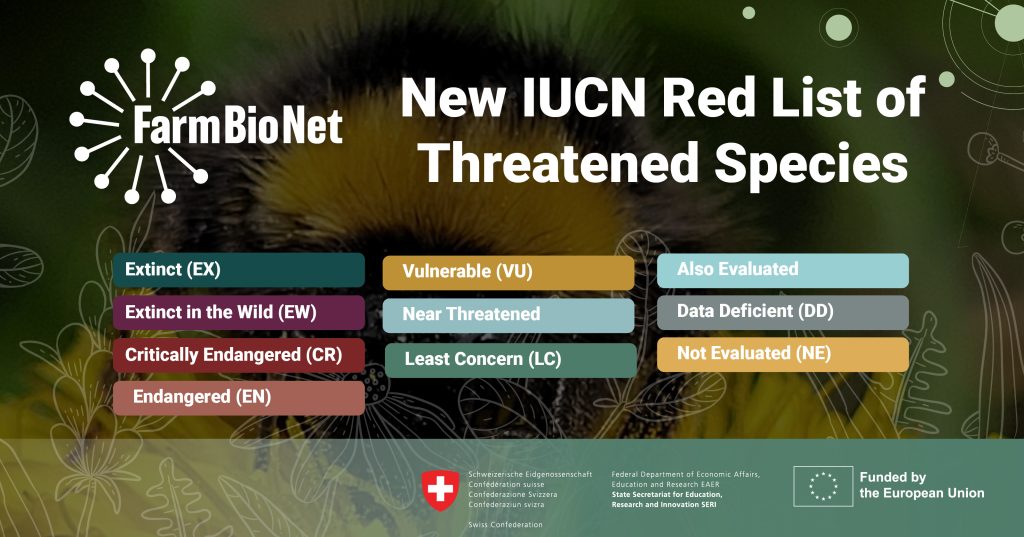
The IUCN Red List Categories and Criteria provide a widely recognised system for classifying species based on their risk of global extinction. The system divides species into nine categories, ranging from those that are well-studied and relatively safe to those that are already extinct:
Not Evaluated (NE) – Species that have not yet been assessed against the Red List criteria.
Data Deficient (DD) – Species for which there is insufficient information to determine their risk of extinction, often due to unknown distribution or population status.
Least Concern (LC) – Species that have been evaluated but do not meet the criteria for any of the threatened categories (Critically Endangered, Endangered, Vulnerable, or Near Threatened).
Near Threatened (NT) – Species that are close to qualifying for a threatened category or are likely to qualify in the near future.
Vulnerable (VU) – Species facing a high risk of extinction in the wild.
Endangered (EN) – Species at a very high risk of extinction in the near future.
Critically Endangered (CR) – Species at an extremely high risk of extinction in the immediate future.
Extinct in the Wild (EW) – Species that only survive in captivity, cultivation, or as a naturalised population.
Extinct (EX) – Species for which there is no reasonable doubt that the last individual has died.
Changes in Europe’s Pollinator Populations
According to the new IUCN Red List of Threatened Species, Europe’s bees and butterflies are facing a decline, with nearly 100 more wild bee species now considered threatened with extinction. This growing danger is particularly evident in key pollinator groups, with over 20% of bumblebee and cellophane bee species now at risk of extinction.
In total, 172 out of 1,928 wild bee species in Europe are now threatened with extinction, compared with 77 species in 2014. Twenty-one species of bee are currently at an extremely high risk of extinction in the immediate future, including Bombus cullumanus (Cullumanus bumblebee), Colletes merceti and Simpanurgus phyllopodus, all important speciesfor pollinating crops and wild plants.
Butterflies are also facing a similar decline. The number of threatened European butterfly species has increased by 76% over the past decade. Today, 15% of Europe’s butterflies face a risk of extinction, up from 37 species in 2010. Over 40% of butterfly species unique to Europe are now threatened or near threatened. The Madeiran large white (Pieris wollastoni), once confined to the Portuguese island of Madeira, has now been officially declared Extinct.
Major Threats to Europe’s Pollinators
Pollinators play a crucial role in maintaining healthy ecosystems, and their survival is essential for nature and humans. Some of the major threats to pollinators highlighted in the assessment report include:
Land-use change. Many pollinators depend on traditional rural landscapes, particularly flower-rich meadows. Agricultural and forestry intensification, combined with land abandonment in less productive areas, is fragmenting and degrading these vital habitats. For example, the shiny dufourea bee (Dufourea minuta), once common across central European plains, has almost disappeared and is now classified as Endangered.
Climate change. According to the assessment, climate change now affects 52% of threatened butterfly species, roughly twice as many as in the previous evaluation. Rising temperatures, heatwaves, droughts, and wildfires are damaging butterfly habitats in southern Europe. Some species, like the Critically Endangered Nevada grayling (Pseudochazara williamsi), are now limited to just a few mountain ranges in southeast Spain due to a combination of habitat loss and climate impacts. Warming temperatures are affecting bee species in different ways. Cold-adapted species, including many bumblebees, are struggling, while others, such as carpenter bees, are benefiting from longer growing seasons that speed up development and reproduction.
FarmBioNet: Restoring Farmland Biodiversity, Protecting Pollinators
In 2025, the FarmBioNet project was launched with a vision to involve those who are in direct contact with nature in biodiversity protection. The way farmers manage their land strongly affects biodiversity. This is why FarmBioNet places farmland biodiversity at the centre of its activities.
The project brings together farmers, foresters, researchers, advisors, and other key stakeholders to foster knowledge exchange and turn research findings into practical solutions for protecting farmland biodiversity. By promoting biodiversity-friendly practices, FarmBioNet helps farmers make changes on their land that benefit both nature and agriculture. Many of these practices also directly support pollinators. For example, allowing wildflowers to grow naturally, providing a variety of natural nesting habitats, planting native trees, and allowing woodland regeneration.