Expert Insights from Stanimira Ivanova: Connecting European Knowledge with Local Realities
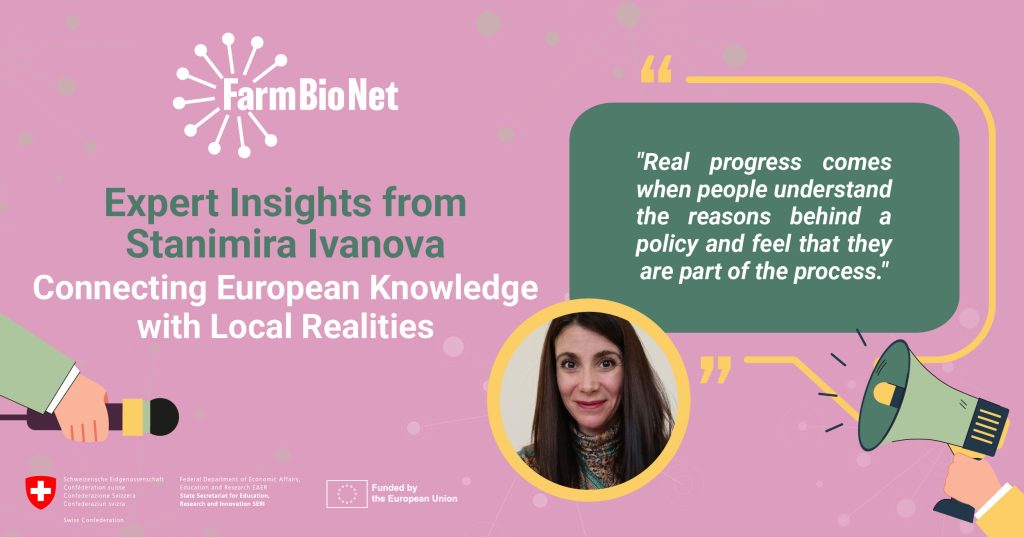
In this edition of our Expert Insights series, we speak with Stanimira Ivanova from the University of Forestry, which leads the Bulgarian FarmBioNet National Network. With ten years of experience in environmental projects, particularly wetlands and ecosystem services, she shares her perspectives on putting environmental policies into practice, strengthening biodiversity and climate resilience in farming, and building a strong National Network through trust and personal connections.
Could you tell us a bit about your professional background and what led you to work in ecology, environmental protection and biodiversity?
For the past ten years, I have been developing and coordinating environmental projects at the University of Forestry in Bulgaria, where I am also currently a PhD candidate.
My particular passion is wetlands and the ecosystem services they provide. Between 2016 and 2020, I coordinated a national project focused on mapping and inventorying wetlands in Bulgaria. This experience opened the door to many other initiatives aimed at raising awareness and improving wetland conservation at national, regional and local levels.
Over the years, I have also been involved in environmental policy discussions, working groups and initiatives related to biodiversity, ecosystem services and nature-based solutions. Much of my work involves bringing together researchers, public authorities and local stakeholders through workshops, meetings and living labs.
What I enjoy most is seeing something move beyond a project document and become useful in real life. When people recognise the value of our work, when they become interested and involved, and especially when an initiative continues after a project has ended, that is incredibly rewarding for me.
Over the past decade, you have worked on research, consultancy and projects related to environmental policy and international best practices. From your experience, what is needed to turn good environmental policies into effective action on the ground?
I believe the most important things are continuity, communication and trust.
We have many good environmental policies in Europe. The challenge is often not the policies themselves, but how they are understood and implemented in practice.
People need to know why a certain measure is important. More importantly, they need to understand what it means for them. What are the benefits? What could happen if we do nothing? How will it affect their work, their land or their community?
Of course, clear rules and effective monitoring are also necessary. But I don’t think that regulations and sanctions alone can bring lasting change.
From my experience, real progress comes when people understand the reasons behind a policy and feel that they are part of the process.
There is also another challenge. Turning a new environmental idea into an actual policy can take years. It requires patience, scientific evidence, dialogue and a lot of persistence. But when you finally see progress, it makes the effort worthwhile.
How do you see the relationship between biodiversity conservation and climate change mitigation and adaptation? Where can farming and rural landscapes contribute most?
For me, biodiversity conservation and climate change are closely connected. We cannot really address one without considering the other.
Everything in an ecosystem is linked. Changes in temperature, rainfall or water availability affect habitats and species. They can change how species behave, feed, reproduce or move. Some species may disappear from certain areas, while others may move into new ones. These changes can then affect the whole ecosystem and the services it provides.
This is why adaptation and preparedness are so important.
Agriculture and rural landscapes have a huge role to play here. Farmers manage large areas of land, and their everyday decisions can make a real difference.
Even relatively simple practices can help. Maintaining hedgerows and field margins, protecting natural vegetation, improving soil health, reducing unnecessary chemical inputs and preserving small wetlands or ponds can support biodiversity and make agricultural landscapes more resilient.
Healthy soils retain water better. Diverse landscapes provide habitats for pollinators and other beneficial species. Natural vegetation can help reduce erosion and protect against extreme weather.
I think we should see biodiversity not as something separate from farming, but as something that can help farming become more resilient to climate change.
What do you see as some of the main challenges for protecting biodiversity in Bulgarian agricultural landscapes, and where do you see the greatest opportunities for positive change?
I think one of the biggest challenges is convincing farmers that protecting biodiversity can also bring benefits to their own farms.
And I completely understand why this is not always easy.
Farmers have to make a living. They face increasing costs, uncertain markets and changing weather conditions. Asking them to change their practices without showing clear benefits or providing enough support is simply not realistic.
We need to demonstrate the value of biodiversity in a practical way. Not only its environmental benefits, but also what it can mean for soil fertility, water availability, pollination and the long-term productivity of their land.
I see great opportunities in working directly with farmers who are already applying biodiversity-friendly practices, sometimes without even calling them that.
Bulgaria has a rich diversity of agricultural landscapes, including traditional pastures, grasslands and small-scale farming areas. Many of these landscapes have developed through generations of farming and support valuable biodiversity.
We should recognise and support the farmers who help maintain them.
I also believe that seeing successful examples is much more convincing than simply hearing about them. When farmers can visit another farm, talk to someone facing similar challenges and see the results for themselves, they are much more likely to consider trying something new.
As the leader of the Bulgarian National Network within FarmBioNet, what are your main priorities for bringing together farmers, researchers, advisors, policymakers and other stakeholders?
For me, it all starts with personal contact and mutual trust.
When we started building the Bulgarian National Network, I didn’t want it to be just another formal group of stakeholders. I wanted people to feel comfortable sharing their experiences, asking questions and speaking openly about their challenges.
And I think we have managed to create something special. We have become a small community of people who know each other, respect each other and share a common interest in biodiversity-friendly farming.
Of course, we come from different backgrounds. Farmers, researchers and advisors do not always see things in the same way. But that is exactly why bringing them together is so valuable.
My priority is to keep this dialogue open and practical. I want farmers to feel that their experience matters just as much as scientific knowledge. I also want researchers and policymakers to better understand what happens on the ground.
For me, the real success of the network is not simply how many people participate, but whether they stay connected, exchange ideas and continue working together.
FarmBioNet aims to connect knowledge, research and practical experience across Europe. What do you think National Networks can bring to this process, particularly in the Bulgarian context?
I think National Networks have a very important role because they connect European knowledge with local realities.
A practice that works well in one country may not work in exactly the same way in another. Farming conditions, landscapes, economic situations and traditions are different.
This is why we need people who understand the local context and can help adapt good ideas to real conditions.
In Bulgaria, I think there is still a gap between scientific knowledge, environmental policies and everyday farming practices. We have valuable research and many experienced farmers, but they do not always have enough opportunities to exchange knowledge.
National Networks can help close this gap.
They also give farmers a stronger voice. Through the network, we can better understand their needs, the difficulties they face and what kind of support would actually help them.
At the same time, being part of a European network allows us to learn from other countries and share our own experience.
I find this exchange particularly valuable. Sometimes a solution to a problem we are facing has already been tested somewhere else. We just need the opportunity to learn about it and see whether it could work in our own conditions.
Is there an example of a practice or approach from another country that you think could be particularly valuable for supporting biodiversity-friendly farming in Bulgaria?
Within FarmBioNet, we have identified a range of biodiversity-friendly farming practices across Europe. I believe all of them could also be applied in Bulgaria, with some adaptation to local conditions.
What I find particularly valuable is the opportunity to learn from real examples and see how these practices work in different countries. We don’t always need to invent something new. Sometimes we just need to learn from each other and adapt what already works.
Looking ahead, what changes in policy, practice or collaboration do you think are most important to strengthen biodiversity-friendly farming?
Farmers need stronger and more reliable financial support for biodiversity-friendly practices.
We cannot expect them to take all the risks and cover all the costs of measures that benefit the wider society.
At the same time, financial incentives alone are not enough.
We need better access to information, practical advice and opportunities for farmers to learn from each other. We also need to make scientific knowledge easier to understand and use.
I believe initiatives such as FarmBioNet are very important because they bring together people who would otherwise rarely have the chance to talk to each other.
Researchers need to listen to farmers. Policymakers need to understand the practical challenges. And farmers need to be involved in discussions about measures that will directly affect their work.
I would also like to see more continuity. Too often, valuable initiatives end when the project funding ends. We need to build relationships and structures that can continue working in the long term.
For me, the key is simple: better dialogue, practical support and long-term commitment.
Finally, what would you say to farmers, researchers or other stakeholders who are interested in becoming more involved in biodiversity-friendly farming
I would say: Give it a chance. You don’t have to change everything at once. Start with something small, learn from the experience and talk to others who are already doing it. The results may not come immediately. Nature needs time, and sometimes the benefits are not easy to see or measure in the beginning. But I believe the results can be lasting. And don’t try to do everything alone. There are people, organisations and networks ready to share knowledge, experience and support.
I have seen how much can happen when people with different backgrounds come together around a common goal.
So my message is simple: get involved, be patient and keep going. It is worth it.